The better choice isn’t always the bigger project. It’s the space you’ll actually use.
That matters a lot when you’re planning home improvements for retirement.
For many years, your outdoor space may have been something you used only when you had time. Maybe you sat outside on Saturday morning before running errands. Maybe friends came over once in a while. Or maybe you enjoyed the patio after work when the weather was nice.
Retirement can change that.
You may have more time to enjoy your home during the day. Morning coffee can last longer. Lunch can move outside. Friends can stay for another hour. You may also have more time with children and grandchildren.
That can make your patio feel more important than it did before.
But not every homeowner wants the same kind of outdoor space.
One person may want a shady place to sit with coffee and read the paper. Another may want a more enclosed space for meals, card games, family visits, and evenings outside.
That is why the choice between a covered patio and a screen room should not start with size, price, or which project seems more impressive.
Start with one simple question:
How do you want to spend your time outside?
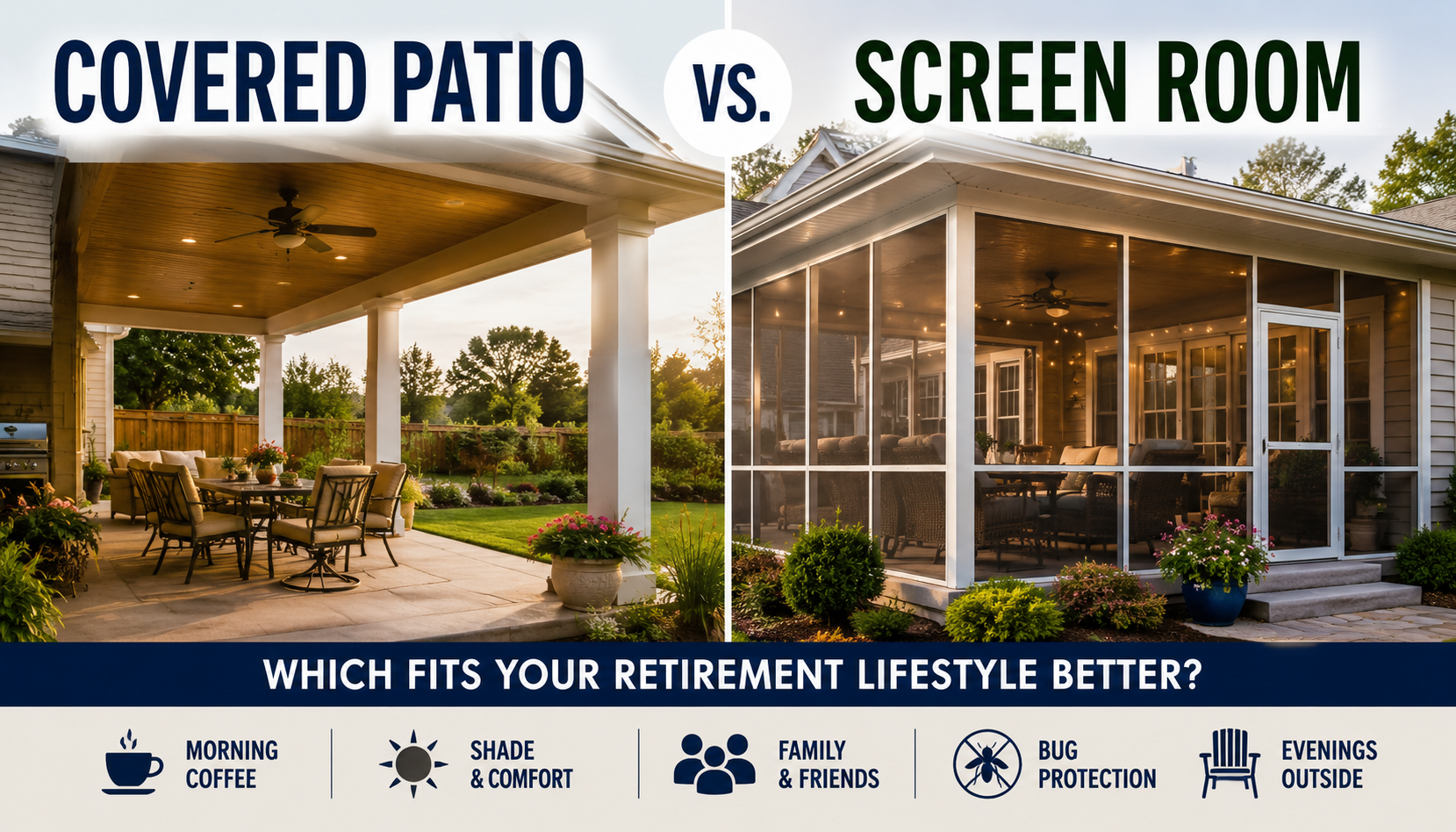
A covered patio gives you shade and protection overhead while keeping the area open on the sides.
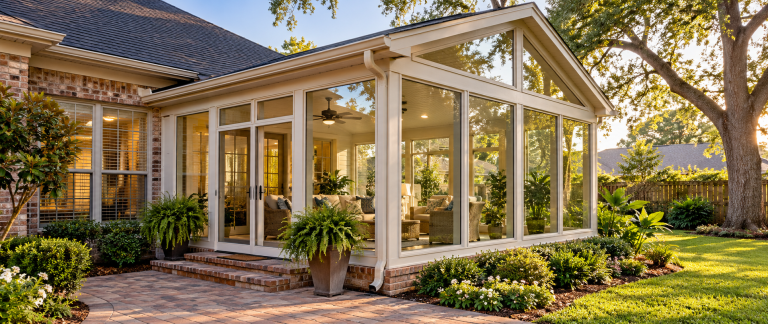
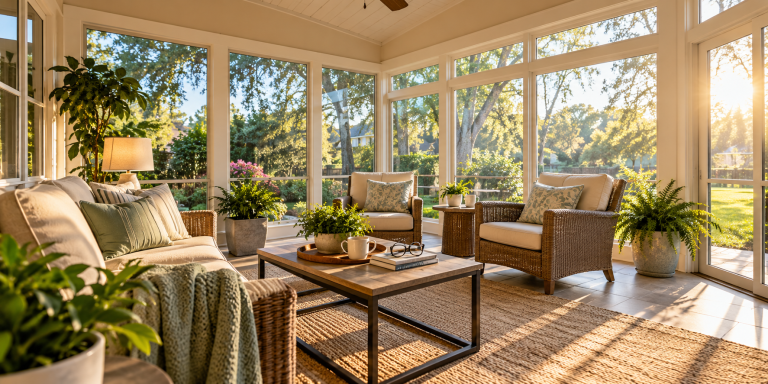
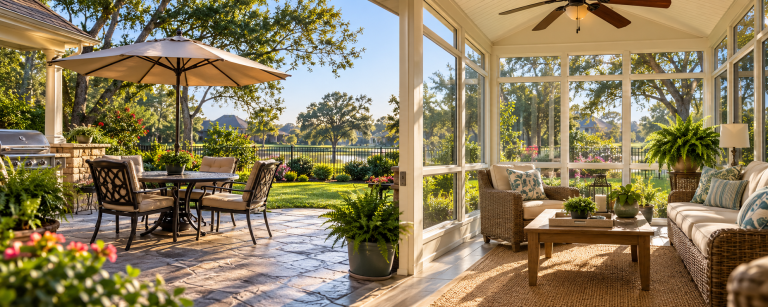
A screen room gives you a more defined outdoor space with screens around it. That can make longer meals and evening visits more comfortable when insects are active.
Both can improve outdoor living.
The best choice depends on how you plan to use the space.
Key Takeaways
- A covered patio may be the better fit if your main goal is shade, open-air comfort, and a clear connection to the backyard.
- A screen room may make more sense if you want to spend longer periods outside, especially for meals, family visits, card games, and evening gatherings.
- Think about when you will use the space most. Morning use may point toward shade as the main need, while evening use may make insect protection more important.
- Your everyday routine should carry more weight than the occasional large gathering. Plan for how you will use the space most weeks.
- Louisiana sun, heat, humidity, rain, and mosquitoes can all affect outdoor comfort. Focus on the problem that most often sends you back indoors.
- A screen room is still an outdoor space. It does not provide the same level of climate control as an indoor room.
- The best choice is not always the larger project. It is the one that fits how you expect to spend your retirement years.
Start With Your Retirement Routine
Before thinking about the project itself, think about a normal day.
Imagine waking up on a Tuesday morning with no work schedule to follow.
Would you take your coffee outside?
Would you sit there for 30 minutes, or would you stay for two hours?
Would you read a book, check the news, or talk with your spouse?
Now think about the afternoon.
Would you sit outside alone? Would a neighbor stop by? Would you have lunch on the patio?
Then think about the evening.
Do you like the idea of eating outside? Do you enjoy sitting outdoors after dinner? Do mosquitoes usually make you head back inside?
These details matter more than they may seem.
Imagine one retired couple who loves the backyard. They spend most mornings outside. They sit with coffee, read, and talk for about an hour. They like the breeze and want a clear view of the yard. Their biggest problem is the sun.
Now imagine another couple.
Their adult children live nearby. The grandchildren visit often. Friends come over for dinner. They enjoy sitting outside after sunset, but insects often make everyone move indoors.
Both couples want a better outdoor space.
But they may need very different projects.
The first couple may get everything they need from a covered patio.
The second couple may be happier with a screen room.
That is why your daily routine should help guide the choice.
When a Covered Patio May Fit You Better
For some homeowners, the main problem is simple.
They need shade.
The patio may already be large enough. The backyard may already look the way they want. They may enjoy the open air and the view.
But when the sun shines directly on the patio, they do not stay outside long.
A covered patio can change that.
You Mainly Want Shade
Imagine it is 9:00 in the morning.
You make another cup of coffee and step outside. The yard is quiet. You have a book or newspaper with you.
You would like to sit there for an hour.
But the patio is already getting hot in the sun.
In this case, your problem is not that you dislike being outside.
You just need more shade.
A patio cover gives you protection overhead while keeping the rest of the area open. You can still feel the breeze. You can still see the yard clearly. You can still walk from the patio into the garden or lawn with ease.
For homeowners looking into patio covers Metairie, this is an important point.
You do not always need more walls or more enclosure.
If the sun is the main reason you do not use your patio, shade may be enough to make the space much more useful.
You Want the Patio to Feel Open
Some homeowners do not want their patio to feel like another room.
They want it to feel like the outdoors.
They want to look across the yard without screens around them. They want air moving through the space. They want to be able to step out onto the lawn without feeling like they are leaving one room and entering another.
That open feeling can be a big part of the appeal.
Think about a retired couple who uses the patio almost every morning.
They usually sit outside for 45 minutes. Sometimes a neighbor joins them. Once in a while, they eat lunch outside.
They do not need a place for long evening gatherings.
They mainly want a cool, shaded place where they can enjoy the yard.
For them, a covered patio may fit very well.
It may not be the larger project, but it could become one of the most-used areas of the home.
When a Screen Room May Fit You Better
Now imagine a different kind of outdoor routine.
Instead of stepping outside for coffee, you are setting the table for dinner.
Your daughter and son-in-law are coming over. The grandchildren are playing in the yard. Everyone sits down to eat.
Dinner lasts longer than usual because no one is in a hurry.
After the plates are cleared, everyone stays at the table and keeps talking.
That kind of outdoor time may call for something different.
When you plan to stay outside for several hours, insects can become a bigger problem.
A few mosquitoes may not bother you much during a quick cup of coffee.
But they can become very annoying during a long meal or an evening with friends.
That is where a screen room may fit better.
You Want to Stay Outside Longer
Ask yourself how long you want to use the space at one time.
If you usually want to sit outside for 20 minutes or an hour, shade may be your biggest need.
If you want to stay outside for two or three hours, you may have other needs as well.
Maybe you want to play cards with friends.
Maybe you want to eat dinner outside.
Maybe you want a place where you can read for most of the afternoon.
A screen room is still an outdoor space. It does not turn the patio into an indoor room.
But the screens create a barrier between you and many of the insects outside.
That can make a big difference when you want to stay outside longer.
You Enjoy Evenings Outdoors
The time of day also matters.
A patio that feels great at 8:00 in the morning may feel very different at 7:00 in the evening.
Think about a warm evening after dinner.
The sun is lower. No one has anywhere else to be. You and your spouse want to sit outside and talk.
Then the mosquitoes start bothering you.
If that happens often, it tells you something about your needs.
For homeowners who enjoy meals and evenings outside, screening may offer more day-to-day value.
Capital Improvement’s screen rooms are built for homeowners who want a more defined outdoor living space while still staying connected to the backyard.
Morning Coffee or Sunday Dinner?
Sometimes the easiest way to choose is to stop thinking about the two projects and focus on the activity.
Start with morning coffee.
You walk outside, sit in your favorite chair, and read for an hour.
You want shade. You want fresh air. You want a clear view of the yard.
A covered patio may be a very good fit.
Now think about Sunday dinner.
Your children are visiting. The grandchildren are playing in the yard. Everyone sits down to eat.
After dinner, no one wants to leave.
You stay outside for another hour or two.
In that case, insects and longer use may matter more.
A screen room may fit better.
Now think about friends coming over to play cards.
If you only play for an hour in the afternoon, a covered patio may be enough.
If those games often last into the evening, screening may become more useful.
The activity can help make the choice clearer.
Two homeowners can have the same size patio and make different choices.
One may use a covered patio every morning.
Another may use a screen room every evening.
Both can make the right choice because they are choosing based on how they live.
How Open Do You Want the Space to Feel?
A covered patio and a screen room feel different.
That feeling matters.
With a covered patio, you are under shelter, but the sides are open.
You can see the whole yard with nothing around you. You can feel the air moving through the space. You can walk into the lawn or garden without passing through a screened area.
Some homeowners love that.
They want the patio to feel like part of the backyard.
A screen room feels more like a separate outdoor area.
You can still see the yard. You can still enjoy the outdoors. But the screens create a clear border around the space.
That can make the area feel more like a place where people sit down and stay for a while.
A table and chairs may feel more settled there. Family members may gather there for meals. Friends may sit there for hours.
Neither feeling is better than the other.
The better choice depends on what you enjoy.
Ask yourself this:
Do you want a shady place in the backyard, or do you want a more defined outdoor room that looks out onto the backyard?
Your first answer may tell you a lot.
Think About Family and Friends
Retirement may also change how often people visit your home.
Adult children may stop by more often.
Grandchildren may spend weekends with you.
Friends may come over for lunch or dinner.
Neighbors may stop by just to talk.
Your outdoor space can become part of those visits.
But it still helps to think about how often larger gatherings happen.
Imagine that you have 12 people over twice a year.
Most of the time, though, the patio is used by just you and your spouse.
In that case, it may not make sense to plan the entire project around those two large gatherings.
Your daily use matters more.
Now think about another family.
Children and grandchildren are at the house almost every weekend. Friends come over often. Birthdays and family meals usually happen in the backyard.
For that homeowner, a more defined screen room may get a lot of use.
The goal is to plan for the life you really live.
Do not plan only for the biggest party of the year.
Plan for the mornings, afternoons, and weekends that happen all the time.
What About New Orleans Weather?
Outdoor living in Metairie and New Orleans comes with some challenges.
The sun can be strong.
Heat and humidity are common.
Rain can change your plans.
Mosquitoes and other insects can make a nice evening much shorter.
That does not mean you cannot enjoy the outdoors.
It means you should think about which problem keeps you inside most often.
A patio cover mainly changes what happens above you.
It gives you shade and overhead protection.
That can make an uncovered patio much more pleasant during the day.
Homeowners looking for patio covers New Orleans should think about when they want to use the patio most.
If direct sun is the main problem, a covered patio may fit your needs well.
A screen room handles a different problem.
It adds screens around the outdoor living area.
If you already have a place that feels good until insects appear, screening may help you use it longer.
Neither option makes the weather disappear.
The goal is to choose the one that solves the problem that bothers you most.
One good way to figure that out is to pay attention to your current patio.
The next few times you go outside, notice what happens.
What time did you go out?
How long did you stay?
What made you uncomfortable?
Why did you go back inside?
Those answers can tell you a lot about the kind of space you may enjoy most.
Think About the Next Five or Ten Years
A retirement home improvement should make sense for more than one summer.
Think about how you expect to use your home in the years ahead.
Will you spend more time at home?
Will family visit more often?
Will you travel less?
Do you want your home to become a place where friends and family gather?
Maybe you are still working now, but retirement is getting closer.
You may not use the patio much during the week today.
That could change once your schedule changes.
Imagine a homeowner who starts out thinking a screen room must be the better choice because it seems like a bigger project.
Then someone asks how the space will be used.
The answer is simple.
Coffee in the morning.
Reading in the afternoon.
Sitting outside with a spouse.
Maybe a neighbor comes over once in a while.
After talking about it, the homeowner sees that shade is really the main need.
Now imagine another couple.
They start out thinking all they need is a patio cover.
But when they talk about the future, they keep mentioning outdoor dinners, grandchildren, friends, and evenings outside.
Their first thought was shade.
Their real goal is a place for longer gatherings.
A screen room may fit them better.
Thinking ahead does not mean you have to know exactly what life will look like in ten years.
It means choosing a project that fits the way you expect to live.
Watch How You Use Your Patio Now
You do not need a long worksheet to make this decision.
Spend a week paying attention to your habits.
Each time you think about going outside, notice what you want to do.
Do you want coffee?
Do you want to read?
Do you want to eat lunch?
Do you want to sit with friends?
Then notice what gets in the way.
Is the patio too sunny?
Do mosquitoes make you go inside?
Is there no good place for four people to sit together?
Would the patio be fine if it only had shade?
These simple details can help when you talk with a contractor.
Instead of saying, “I think I need a screen room,” you can say:
“We want to eat outside two or three nights a week, but mosquitoes usually make us go inside.”
Instead of saying, “I need something over the patio,” you can say:
“We sit outside almost every morning, but once the sun reaches the patio, we stop using it.”
That tells the contractor much more about what you need.
The project should be built around how you plan to live in the space.
Conclusion
A covered patio and a screen room can both make outdoor living more enjoyable.
The better choice depends on how you want to spend your retirement years.
If you see yourself drinking coffee outside, reading in the shade, talking with your spouse, and enjoying an open view of the backyard, a covered patio may be the better fit.
If you see yourself eating meals outdoors, having grandchildren over, playing cards with friends, and staying outside later in the evening, a screen room may make more sense.
The biggest project is not always the best project.
The best project is the one that fits your everyday life.
Think about how long you want to stay outside. Think about what time of day you will use the space. Think about who will be there with you. Most of all, think about what keeps you from using your patio more often right now.
Those answers can help you choose a space you will enjoy for years.
Capital Improvement has served homeowners across Greater New Orleans with a focus on reliability, craftsmanship, and outdoor living improvements designed for the way people live.
When You Hire Us, We’ll Be There!
If you’re thinking about adding a covered patio or screen room to your home, visit https://www.capitalimprovement.com/contact/ or call 504-733-5722 to schedule your consultation with Capital Improvement.
Frequently Asked Questions
Is a covered patio or screen room better for retirement?
Neither option is better for every homeowner. A covered patio may be a better fit if you mainly want shade and an open view of the yard. A screen room may be a better choice if you want to spend longer periods outside for meals, family visits, games, or evening conversations.
What is the main difference between a covered patio and a screen room?
A covered patio provides overhead shade and protection while keeping the sides open. A screen room adds screening around the outdoor living area, creating a more defined space and helping reduce contact with mosquitoes and other insects.
Is a screen room considered an indoor room?
No. A screen room is still an outdoor living space. It does not provide the same type of climate control as a conditioned indoor room.
Which option is better for morning use?
If you mainly want a comfortable place for morning coffee, reading, or casual conversation, a covered patio may be enough. The open sides allow airflow while the roof provides shade from direct sun.
Which option is better for evenings?
A screen room may be more useful for homeowners who want to spend evenings outside. Screening can help make the space more comfortable when mosquitoes and other insects become active.
Is a covered patio good for entertaining?
Yes. A covered patio can work well for casual visits, lunches, and gatherings, especially for homeowners who prefer an open-air setting. The better choice depends on how long you expect guests to stay and whether insects are a frequent problem.
Is a screen room good for grandchildren and family gatherings?
It can be. A screen room creates a more defined outdoor space for meals, games, conversations, and family time while still keeping a visual connection to the backyard.
How should I decide which project fits my home?
Pay attention to how you already use your patio. Notice what time of day you go outside, how long you stay, what you enjoy doing there, and what causes you to go back indoors. Those habits can help show whether shade, screening, or a more defined gathering space matters most.
Should I plan around large family gatherings?
Large matter, but they should not be the only factor. If you and your spouse will use the patio several dgatherings ays each week, your regular routine may be more important than a large event that happens only once or twice a year.
What should I discuss with a patio or screen room contractor?
Explain how you want to use the space, not just what type of project you think you need. Talk about when you will use it, how many people usually gather there, whether sun or insects are the main problem, and how long you expect to stay outside.
This article is a collaboration between Capital Improvement and OpenAI’s ChatGPT. Created on Aug 10, 2026, it combines AI-generated draft material with Capital Improvement’s expert revision and oversight, ensuring accuracy and relevance while addressing any AI limitations.
Recommended Reading
1. “Mosquito Control at Home” — Centers for Disease Control and Prevention
The CDC explains practical ways mosquitoes enter and affect outdoor living areas, along with steps homeowners can take to reduce mosquito activity around the home. For professionals planning screened spaces, this provides useful context for understanding why screening can have strong lifestyle value in warm, humid regions.
2. “Reducing Urban Heat Islands: Compendium of Strategies — Cool Pavements” — U.S. Environmental Protection Agency
This EPA resource explains how outdoor surface materials and solar exposure affect heat around homes and developed areas. While it focuses on pavement rather than patio covers, it adds useful technical context for professionals thinking about shade, surface temperature, and outdoor comfort in hot climates.
3. “Building America Solution Center” — U.S. Department of Energy
The Building America Solution Center provides research-based guidance on residential design, moisture, climate, durability, and building-envelope performance. It is especially useful for professionals who want broader technical context when planning additions and exterior structures in hot-humid regions such as South Louisiana.