Table of Contents
- What Homeowners Get Wrong When Comparing Patio Cover Quotes
- Introduction: Why Comparing Prices Can Be Misleading
- Key Takeaways
- Mistake #1: Thinking All Patio Covers Are the Same
- Mistake #2: Not Looking Closely at What’s Included
- Mistake #3: Not Thinking About Installation Quality
- Mistake #4: Using Price Per Square Foot to Compare Quotes
- Mistake #5: Not Understanding Structural Requirements
- Mistake #6: Choosing Based Only on Speed
- Mistake #7: Focusing Only on the Upfront Price
- Mistake #8: Not Considering the Contractor
- How to Compare Patio Cover Quotes the Right Way
- Conclusion: Making the Right Decision for Your Patio Cover
- Frequently Asked Questions
- 1. Why do patio cover quotes vary so much in price?
- 2. What should I look for when comparing patio cover quotes?
- 3. Are insulated patio covers worth the higher cost?
- 4. Why is one contractor’s quote much lower than the others?
- 5. Does installation quality really matter that much?
- 6. Is price per square foot a good way to compare quotes?
- 7. Do patio covers need permits or engineering?
- 8. Should I choose the contractor who can finish the job the fastest?
- 9. How do I know if a quote includes everything I need?
- 10. What is the best way to make the right decision?
What Homeowners Get Wrong When Comparing Patio Cover Quotes
Introduction: Why Comparing Prices Can Be Misleading
When homeowners start looking into a patio cover, the process seems simple.
You reach out to a few companies, get a few quotes, and compare the prices. From there, you choose the option that makes the most sense.
At first glance, that feels like a smart approach.
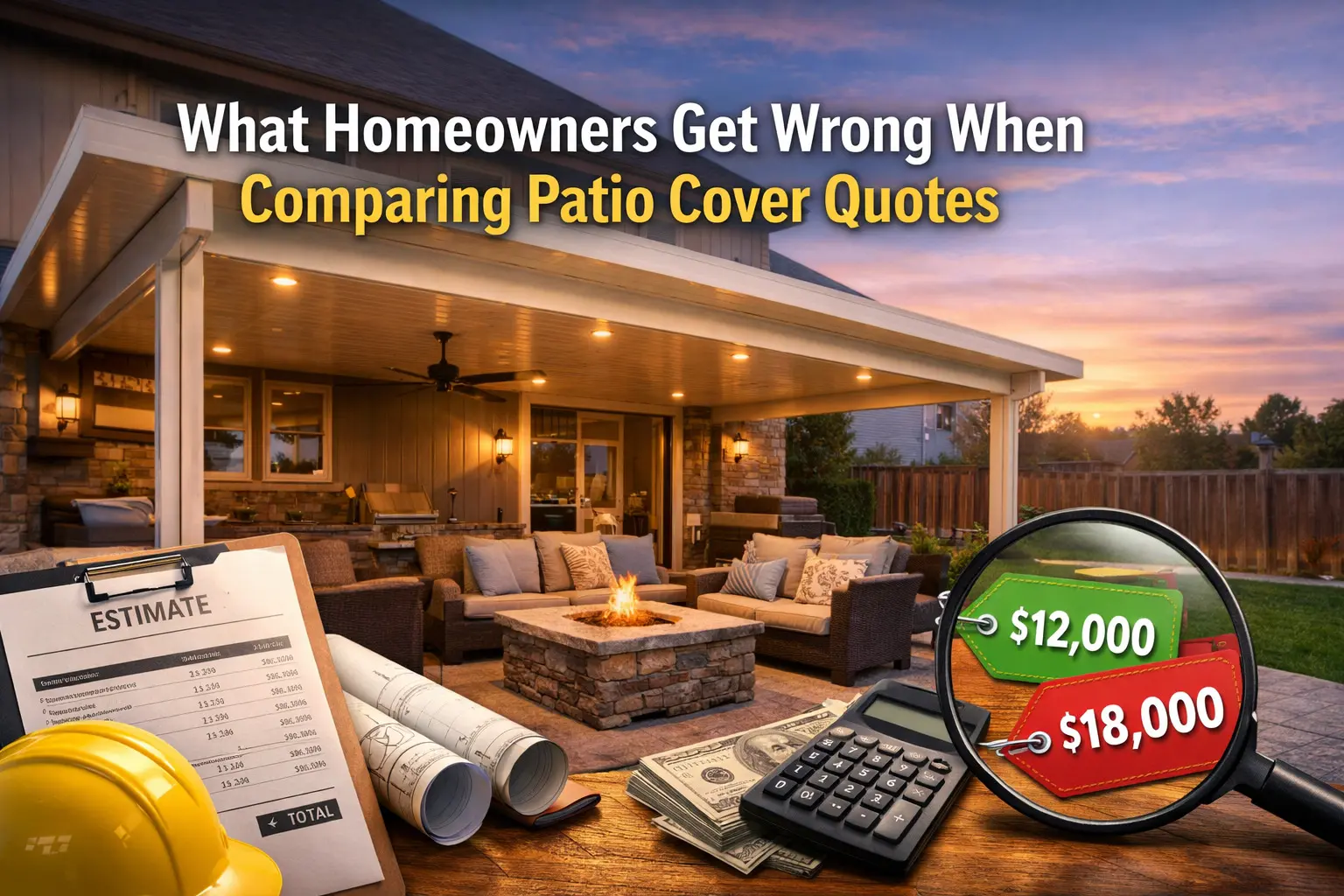
If one company quotes $12,000 and another quotes $18,000, it’s natural to question the difference. Most homeowners assume they are being offered the same thing at two different prices.
That assumption is where problems begin.
Patio cover quotes are not always easy to compare. Two quotes may look similar at first, but once you look closer, the differences become clear. The materials may not match. The design may vary. The way the cover is installed may not be the same.
Because of this, comparing price alone can lead to the wrong conclusion.
This article explains the most common mistakes homeowners make when reviewing patio cover quotes. It also shows what to look for so you can make a decision that works for your home over time.
Key Takeaways
- Not all patio cover quotes are the same.
Two quotes may look similar, but they can include very different materials, designs, and levels of work. - A lower price often means something is missing.
Items like permits, electrical work, or finishing details may not be included in cheaper quotes. - The type of patio cover matters.
Insulated and non-insulated covers perform very differently, especially in heat and rain. - Installation quality affects long-term performance.
Even good materials can fail if the installation is rushed or done incorrectly. - Price per square foot can be misleading.
Every patio cover is custom, so size alone does not explain the full cost. - Structural planning is important in Louisiana.
Patio covers must be built to handle local weather and meet building requirements. - Faster timelines are not always better.
A proper process takes time and helps avoid problems later. - The lowest price is not always the best value.
A cheaper option may cost more over time if it does not last or perform well. - The contractor matters just as much as the product.
Experience, planning, and consistency all affect the final result. - The best comparisons look beyond price.
Understanding what is included, how it’s built, and how it will perform leads to better decisions.
Mistake #1: Thinking All Patio Covers Are the Same
Many homeowners believe that all patio covers are basically the same.
They provide shade. They attach to the home. They create a covered outdoor space. Because of that, it’s easy to assume the only real difference is price.
In reality, patio covers can be built in very different ways.
Some use thin aluminum panels with no insulation. Others use thicker panels with insulation built inside. These differences may not stand out right away, but they affect how the space feels every day.
Homeowners who research insulated patio covers often notice the difference after installation.
An insulated cover helps block heat from the sun, making the space underneath more comfortable during hot weather. It also reduces the sound of rain hitting the roof.
A non-insulated cover may cost less, but it can trap heat underneath. It may also sound louder during storms and feel less solid overall.
Now think about two quotes.
One is for a basic system. The other is for an insulated system. The insulated option costs more.
If both are treated as equal, the lower price seems like the better deal. But once the cover is installed, the difference becomes obvious.
Understanding the type of patio cover being offered is just as important as understanding the price.
Mistake #2: Not Looking Closely at What’s Included
Another common issue comes from not reviewing the full scope of the quote.
Contractors do not always include the same items in their pricing. Some provide a complete, start-to-finish quote. Others present a base price and leave out certain parts.
At first, the lower quote may stand out.
But as the project moves forward, additional costs begin to appear.
These may include permits, electrical work, drainage, or finishing details. Each added item increases the total cost.
Consider a simple comparison.
One contractor includes everything in the original quote. Another leaves out permits and electrical work.
At first, the second quote looks more affordable. Later, once those missing pieces are added back in, the total cost may match—or exceed—the higher quote.
This often leads to frustration because the full scope was not clear from the beginning.
A complete quote makes it easier to understand the total investment from the start.
Mistake #3: Not Thinking About Installation Quality
Materials are important, but installation plays just as large a role in the final result.
A patio cover must be attached properly, sealed correctly, and built to handle water and weather. Small details during installation can affect how well it performs.
Picture two patio covers made from the same materials.
One is installed carefully. Everything is aligned, sealed, and designed for proper drainage.
The other is installed quickly, with less attention to those details.
At first, both may look the same. After a heavy rain, the difference becomes clear. One works as expected. The other may leak or hold water.
For homeowners searching for patio cover installers near me, this is an important point.
The way the work is done affects how long the patio cover lasts and how well it performs.
When comparing quotes, it’s important to think about installation—not just materials.
Mistake #4: Using Price Per Square Foot to Compare Quotes
Some homeowners try to simplify the process by comparing price per square foot.
While this approach seems helpful, it does not always work for patio covers.
Each project is different. Patio covers are built to fit the home they attach to, and that means the work can vary.
One project may be simple and straightforward. Another may involve more complex design, framing, or connections.
Even if two covers are the same size, the cost can differ because the work required is not the same.
When everything is reduced to a single number, those differences are lost.
Looking at the full scope of the project gives a clearer picture than relying on price per square foot.
Mistake #5: Not Understanding Structural Requirements
In South Louisiana, weather conditions affect how patio covers must be built.
Strong winds and storms are common, so structures must meet local building standards.
Some contractors include proper structural planning in their quotes. Others may reduce costs by limiting this part of the project.
At first, this may not seem important. Over time, it can lead to issues.
Permits may be harder to obtain. The structure may not perform well during storms. Long-term durability may be affected.
Homeowners researching patio cover cost may not realize how much structural planning influences pricing.
A well-designed structure is built to handle local conditions, which helps it last longer.
Mistake #6: Choosing Based Only on Speed
It’s natural to want your project completed quickly.
If one contractor offers a fast start date, that can be appealing. However, speed should not be the only factor in your decision.
A well-planned project includes preparation. This may involve design, permits, and scheduling materials.
If a timeline seems unusually fast, it may mean some steps are being rushed or skipped.
This can lead to problems later.
A clear and organized process often leads to better results, even if it takes more time.
Mistake #7: Focusing Only on the Upfront Price
The price listed in the quote is important, but it does not tell the whole story.
A patio cover is a long-term addition to your home. It’s something you will use for many years.
Because of that, it helps to think about long-term performance.
How well will it handle heat and rain? How long will it last? Will it require extra maintenance?
A lower-cost option may save money upfront but may not perform as well over time.
A higher-quality system may cost more at the beginning but provide better performance and durability.
Looking beyond the initial price helps you understand the full value of the investment.
Mistake #8: Not Considering the Contractor
Every quote comes from a contractor, and that plays a major role in the outcome.
Different contractors have different levels of experience and consistency. Some focus on patio covers, while others offer a wide range of services.
At first, these differences may not be obvious. During the project, they become clearer.
The contractor affects how the project is planned, how details are handled, and how the final result turns out.
There are many options available for homeowners searching online.
Choosing based only on price can lead to results that fall short of expectations.
How to Compare Patio Cover Quotes the Right Way
A better comparison starts by looking beyond the price.
Begin by understanding the type of patio cover being offered. Is it insulated or not?
Review what is included in the quote. Are permits, setup, and finishing work part of the price?
Ask how the installation will be handled. Is there a clear plan?
Check whether structural requirements are addressed.
Finally, think about how the patio cover will perform over time.
When these factors are considered together, the differences between quotes become easier to understand.
Conclusion: Making the Right Decision for Your Patio Cover
Many homeowners run into problems when comparing patio cover quotes because they don’t have the full picture.
Focusing only on price makes it easy to overlook important details. Materials, installation quality, design, and planning all affect how your patio cover will look and perform over time.
A patio cover is more than just an outdoor addition. It’s something you will use regularly, and it should be built to last.
Taking the time to understand what each quote includes helps you avoid surprises and make a decision you feel confident about.
If you’re comparing patio cover quotes and want a clear understanding of your options, the next step is to speak with a professional who can walk you through the details.
Visit: https://www.capitalimprovement.com/contact/
Call: 504-733-5722
You’ll receive a detailed, transparent quote along with clear explanations so you know exactly what to expect.
When You Hire Us, We’ll Be There!
Frequently Asked Questions
1. Why do patio cover quotes vary so much in price?
Patio cover quotes can vary because they are not always based on the same materials or scope of work. One quote may include insulation, permits, and finishing details, while another may leave those out. The way the cover is built and installed also affects the price.
2. What should I look for when comparing patio cover quotes?
Look beyond the price. Check what type of system is being offered, what is included in the quote, and how the installation will be handled. It also helps to ask about permits, drainage, and how the structure is designed for your home.
3. Are insulated patio covers worth the higher cost?
Insulated patio covers can provide better comfort, especially in hot weather. They help reduce heat and can make the space quieter during rain. While they cost more upfront, many homeowners find the added comfort makes a difference over time.
4. Why is one contractor’s quote much lower than the others?
A lower quote may leave out important parts of the project. These can include permits, electrical work, or finishing details. In some cases, lower-cost materials or faster installation methods are used. It’s important to ask what is included before making a decision.
5. Does installation quality really matter that much?
Yes, it does. Even high-quality materials can fail if they are not installed correctly. Proper attachment, sealing, and drainage all affect how well the patio cover performs and how long it lasts.
6. Is price per square foot a good way to compare quotes?
Not always. Patio covers are custom-built, and each project is different. The design, layout, and connection to your home can affect the cost. Looking at the full scope of work gives a better comparison than price per square foot alone.
7. Do patio covers need permits or engineering?
In many areas, yes. Local building requirements often require permits and proper structural planning. These steps help make sure the patio cover is safe and built to handle weather conditions.
8. Should I choose the contractor who can finish the job the fastest?
Not just based on speed. A well-planned project takes time for design, permits, and scheduling. A very fast timeline may mean steps are being rushed or skipped.
9. How do I know if a quote includes everything I need?
Not just based on speed. A well-planned project takes time for design, permits, and scheduling. A very fast timeline may mean steps are being rushed or skipped.
10. What is the best way to make the right decision?
The best approach is to compare more than just price. Look at the materials, the installation process, what is included, and how the patio cover is expected to perform over time. This helps you choose the option that fits your needs long term.
This article is a collaboration between Capital Improvement and OpenAI’s ChatGPT. Created on April 14, 2026, it combines AI-generated draft material with Capital Improvement’s expert revision and oversight, ensuring accuracy and relevance while addressing any AI limitations.
External Links:
1. “Residential Patio Covers: Design Loads and Code Requirements”
Provides a detailed look at structural load requirements, including wind and weather considerations, helping professionals better understand how engineering impacts patio cover design and pricing.
URL:https://www.awc.org/codes-standards/publications/dca6
2. “Evaluating Contractor Bids: Beyond the Bottom Line”
Explores how to properly assess construction bids by comparing scope, materials, and execution—not just price—making it highly relevant for understanding why quotes can vary.
URL:https://www.jlconline.com/how-to/business/evaluating-contractor-bids_o
3. “Understanding Construction Cost Estimates”
Breaks down how estimates are developed, including direct and indirect costs, giving insight into why seemingly similar projects can have very different pricing structures.
URL:https://www.agc.org/learn/education-training/construction-estimating-basics