Table of Contents
- The Hidden Cost of Choosing the Lowest Price
- Key Takeaways
- South Louisiana Weather Is Hard on Patio Covers
- What “Cheap” Really Means
- How Cheap Patio Covers Fail Over Time
- The Real Cost Shows Up Over Time
- What to Look for in a Patio Cover That Lasts
- Why the Contractor Matters
- Built for South Louisiana
- Conclusion: Cheap Patio Covers Cost More Than You Think
- Frequently Asked Questions
- 1. Why are some patio covers so much cheaper than others?
- 2. How long do cheap patio covers last in South Louisiana?
- 3. Do patio covers really make a difference in heat?
- 4. What are the signs of a poorly built patio cover?
- 5. Can a patio cover handle strong storms in Louisiana?
- 6. Is it better to invest in a higher-quality patio cover?
- 7. What should I look for in a patio cover installer?
- 8. Are insulated patio covers worth the cost?
- 9. Why do patio covers leak?
- 10. How do I choose the right patio cover for my home?
- External Links:
The Hidden Cost of Choosing the Lowest Price
It usually begins with a simple idea.
You want to enjoy your outdoor space more. Maybe your patio gets too hot during the day. Maybe you want a place to sit outside in the evening without worrying about the weather. So, you decide to add a patio cover.
You start getting quotes.
One contractor gives you a fair price. Another is a little higher. Then one comes in much lower than the rest.
That low number stands out.
At first, it feels like an easy choice. Why spend more if everything looks the same?
But patio covers don’t show their real quality on the day they are installed.
At the beginning, everything looks clean and solid. There are no visible problems. It feels like you made the right decision.
Then time passes.
A few months go by. Then summer arrives. Then storm season follows.
That’s when things begin to change.
You start asking questions:
- Why is it so hot underneath?
- Why does it make noise when the wind picks up?
- Why is water showing up where it shouldn’t?
What once felt like a good deal starts to feel different.
Many homeowners come to the same realization:
The lowest price didn’t save money—it only delayed the problems.
And in South Louisiana, those problems don’t take long to appear.
Key Takeaways
- The lowest price is rarely the best value.
Cheap patio covers may cost less upfront, but they often lead to higher costs over time due to poor performance and early replacement. - South Louisiana weather demands stronger construction.
Heat, humidity, heavy rain, and storms quickly expose weaknesses in low-quality patio covers. - Not all patio covers are built the same.
Lower-priced options often use thinner materials, weaker designs, and rushed installation methods. - Heat is one of the first signs of a poor system.
Non-insulated patio covers trap heat, making your outdoor space uncomfortable and hard to use. - Water and storms reveal deeper problems.
Leaks, shifting, and noise during storms are common signs of poor installation or weak structure. - Cheap patio covers wear out faster.
Materials break down more quickly in humid conditions, leading to a shorter lifespan. - The real cost shows up over time.
What seems like savings at the start often turns into more spending later. - Quality patio covers improve daily comfort.
A well-built system creates a space you can enjoy more often, not avoid. - Installation matters just as much as materials.
Even a good product can fail if it’s not installed properly. - Choosing the right contractor makes the difference.
A reliable contractor focuses on long-term performance, not just getting the job done quickly. - A better-built patio cover is a long-term investment.
It adds comfort, durability, and value to your home.
South Louisiana Weather Is Hard on Patio Covers
Outdoor structures in this area face constant pressure from the weather.
A patio cover isn’t just sitting there—it’s being tested every day.
The heat is strong for much of the year. The sun doesn’t just warm surfaces—it wears them down. Lower-quality materials absorb that heat and send it downward, making the space underneath uncomfortable.
Humidity adds another challenge. Moisture stays in the air and slowly affects materials over time. Metal can weaken. Finishes can fade. What once looked strong begins to change.
Then comes the rain.
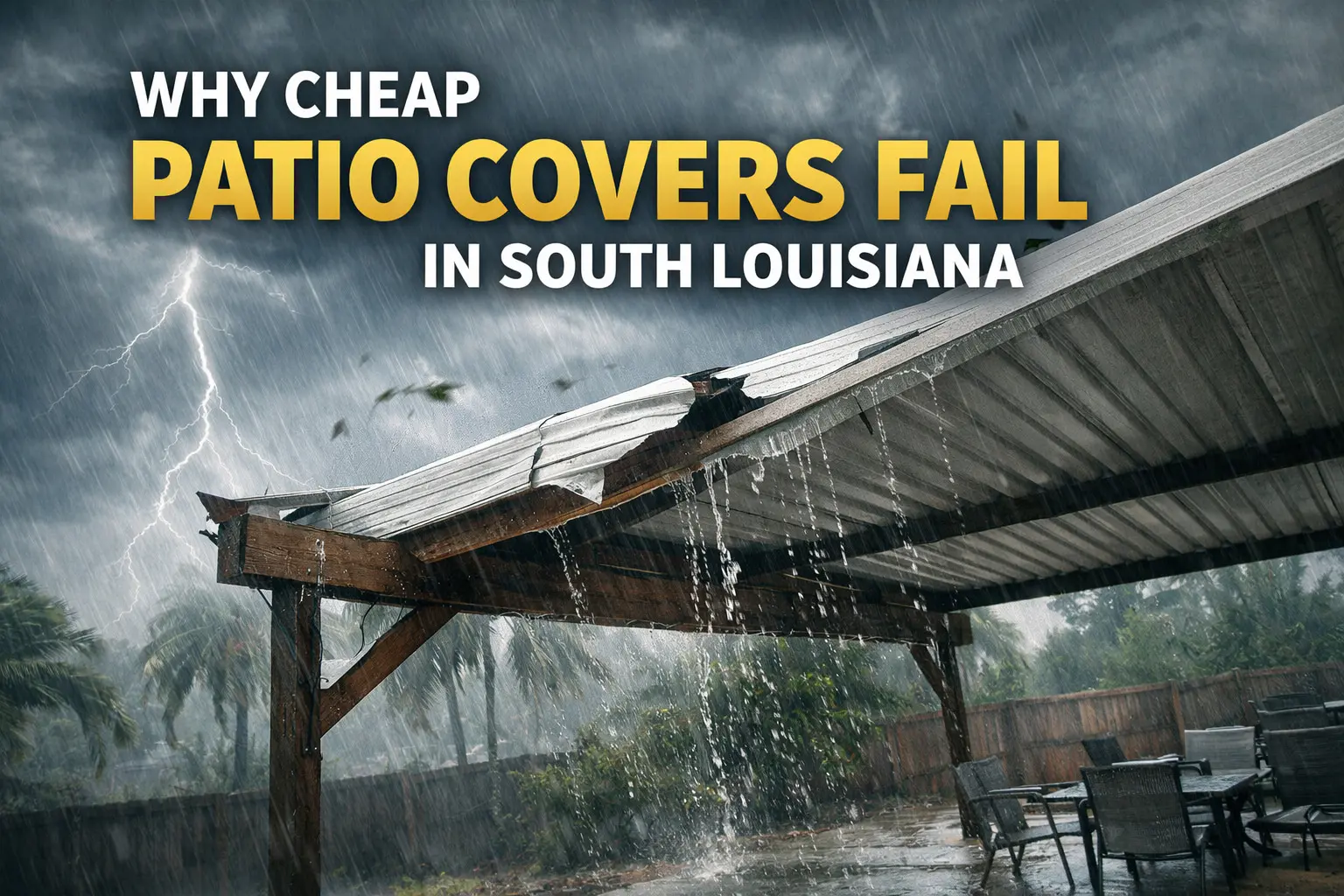
Rain here is heavy and fast. A patio cover has to move water away properly. If it doesn’t, water will collect or find its way through small gaps.
And when storms arrive, everything is put to the test.
Wind pushes and lifts against the structure. Every connection point matters. If something wasn’t built or installed correctly, that’s when it starts to show.
Many low-cost patio covers are built for milder climates. When used in South Louisiana, they face conditions they weren’t designed to handle.
That’s why problems are so common.
What “Cheap” Really Means
A lower price always comes from somewhere.
It may not be obvious at first, but something has been reduced.
Sometimes it’s the materials. Other times, it’s the structure or the installation process. In many cases, it’s a mix of all three.
For example, many lower-cost builds use thin panels that don’t block heat well. That’s why many homeowners later wish they had chosen an insulated patio cover. Insulated systems help keep the space cooler and more comfortable throughout the year.
Structure is another factor. Cheap patio covers often have less support. They may look fine when first installed, but they don’t handle stress as well over time.
Then there’s installation.
This is where many problems begin. If a job is rushed, small details get missed. Seals may not hold. Water may not drain properly. Connections may not be as strong as they should be.
At first, these issues are easy to overlook. But over time, they become clear.
Search trends like “insulated patio roof panels cost” show that more homeowners are starting to look deeper into what they’re actually getting .
How Cheap Patio Covers Fail Over Time
Most patio covers don’t fail all at once.
Instead, problems build step by step.
It Starts with Heat
The first thing many homeowners notice is how hot it gets.
Instead of cooling the space, the patio cover traps heat underneath. The sun heats the surface, and that heat radiates downward.
As a result, the space becomes harder to use—especially during the day.
Then Water Finds a Way In
After that, rain begins to expose weak points.
You might notice a small drip at first. Maybe it only happens during heavy rain.
But over time, it becomes more frequent.
Water follows the path of least resistance. If sealing or design isn’t done properly, it will find its way through.
Storms Reveal Structural Weakness
When stronger weather hits, the structure is tested in a different way.
You may hear movement during high winds. You may notice slight shifting.
This is often when homeowners realize something isn’t right.
Many people searching for patio cover installers near me are dealing with these exact issues.
Wear Becomes More Visible Over Time
As the years pass, material quality becomes more noticeable.
Lower-grade materials begin to wear down faster. The finish fades. Parts weaken. The structure begins to look older than expected.
In this climate, that process happens quickly.
Replacement Becomes the Only Option
Eventually, the problems add up.
At that point, many homeowners decide to replace the patio cover entirely.
What started as a lower-cost option turns into a second investment.
The Real Cost Shows Up Over Time
A cheap patio cover may cost less at the beginning.
But over time, the true cost becomes clear.
It shows up in small frustrations at first, then in bigger issues, and eventually in replacement.
A higher-quality patio cover performs differently.
It holds up to the weather and continues to do what it was designed to do.
Looking at the Bigger Picture
Think of it this way.
One homeowner chooses the lowest price and replaces their patio cover after several years.
Another chooses a higher-quality option and enjoys it for much longer.
In many cases, the second homeowner ends up spending less overall.
Comfort Matters Every Day
This isn’t just about money.
It’s about how you use your space.
A good patio cover gives you a place to relax and enjoy your home.
A poor one limits how often you use it.
It Also Affects Your Home’s Appearance
A well-built patio cover adds to the look of your home.
A poorly built one can take away from it.
That’s important for homeowners researching patio covers Metairie LA, where appearance and durability both matter.
What to Look for in a Patio Cover That Lasts
If you want a patio cover that performs well, focus on a few key areas.
First, insulated roofing helps control heat and improve comfort.
Next, the structure should be strong enough to handle local weather conditions.
Installation should be done carefully, with attention to sealing, drainage, and support.
Finally, the contractor should take the time to do the job right.
Why the Contractor Matters
Two patio covers can look the same but perform very differently.
The difference often comes down to installation.
Small details—like how the structure is attached and how water is directed—make a big impact over time.
When those details are handled correctly, the result is a patio cover that feels solid and lasts longer.
When they are not, problems show up early.
Built for South Louisiana
At Capital Improvement, the goal is simple—build patio covers that last.
We focus on new installations designed for the conditions in South Louisiana.
That means using materials that handle heat and humidity, building strong structures, and taking the time to install everything correctly.
When You Hire Us, We’ll Be There!
You can expect clear communication, reliable scheduling, and a finished result you can count on.
Conclusion: Cheap Patio Covers Cost More Than You Think
A cheap patio cover may seem like a good deal at first.
But over time, the problems start to show.
Heat makes the space hard to use. Rain finds its way in. Storms put stress on the structure. Materials wear down faster than expected.
What looked like savings at the beginning often turns into more spending later.
In South Louisiana, a patio cover has to do more than just look good. It has to handle heat, humidity, heavy rain, and strong winds. When it’s not built for these conditions, it won’t last.
A better-built patio cover gives you something different. It creates a space you can enjoy every day. It holds up through changing weather. It adds comfort and value to your home.
That’s why the right choice isn’t just about price—it’s about how well it performs over time.
If you’re planning a new patio cover, it’s worth doing it right from the start.
At Capital Improvement, we install patio covers built for South Louisiana conditions. Every project is done with care, so you can enjoy your space without worrying about how it will hold up.
When You Hire Us, We’ll Be There!
To get started, schedule your consultation today:
Visit: https://www.capitalimprovement.com/contact/
Call: 504-733-5722
Let’s build a patio cover that lasts.
Frequently Asked Questions
1. Why are some patio covers so much cheaper than others?
Cheaper patio covers usually cost less because of lower-quality materials, less structural support, or faster installation. These differences may not be easy to see at first, but they affect how well the patio cover performs over time.
2. How long do cheap patio covers last in South Louisiana?
In South Louisiana, cheap patio covers often wear out faster due to heat, humidity, and storms. Many begin to show problems within a few years, especially if they are not built for this climate.
3. Do patio covers really make a difference in heat?
Yes, they do. A well-built insulated patio cover can help reduce heat and make your outdoor space more comfortable. Non-insulated covers often trap heat, making the area underneath feel hotter.
4. What are the signs of a poorly built patio cover?
Common signs include:
- Excessive heat underneath
- Leaks during rain
- Noise or movement during wind
- Fading or wear after a short time
These issues often point to poor materials or installation.
5. Can a patio cover handle strong storms in Louisiana?
It can—but only if it is designed and installed properly. A patio cover built for South Louisiana should be able to handle strong winds and heavy rain. Lower-quality systems may struggle during storms.
6. Is it better to invest in a higher-quality patio cover?
In most cases, yes. A higher-quality patio cover lasts longer, performs better, and creates a more comfortable space. Over time, it often costs less than replacing a cheaper system.
7. What should I look for in a patio cover installer?
Look for a contractor who:
Communicates clearly throughout the project
Focuses on new installations
Has experience with local weather conditions
Takes time to install the structure properly
8. Are insulated patio covers worth the cost?
Yes. Insulated patio covers help reduce heat, improve comfort, and add strength to the structure. They are especially useful in hot climates like South Louisiana.
9. Why do patio covers leak?
Leaks usually happen because of poor installation or design. If the patio cover is not sealed correctly or doesn’t have proper drainage, water can find its way through.
10. How do I choose the right patio cover for my home?
Focus on long-term performance, not just price. Choose quality materials, a strong design, and a contractor who installs the system correctly. This helps ensure your patio cover lasts and performs well.
This article is a collaboration between Capital Improvement and OpenAI’s ChatGPT. Created on April 07, 2026, it combines AI-generated draft material with Capital Improvement’s expert revision and oversight, ensuring accuracy and relevance while addressing any AI limitations.
External Links:
1. “Designing for Wind Resistance in Residential Structures”
Summary: This article explains how wind forces affect attached structures and outlines key design principles for improving stability and durability—critical knowledge for understanding why underbuilt patio covers often fail during storms.
URL: https://www.fema.gov/sites/default/files/documents/fema_p-804_wind-resistant-design-concepts.pdf
2. “Moisture Control Guidance for Building Design, Construction and Maintenance”
Summary: Published by the U.S. Environmental Protection Agency (EPA), this guide explores how moisture impacts building materials and structural longevity, offering insight into why humidity-related deterioration is a major issue in coastal regions.
URL: https://www.epa.gov/sites/default/files/2014-08/documents/moisture-control.pdf
3. “The Effects of Heat and UV Exposure on Building Materials”
Summary: This resource examines how prolonged sun exposure degrades common construction materials, helping explain why non-insulated or lower-grade patio covers struggle in high-heat environments.
URL: https://www.nrel.gov/docs/fy13osti/56097.pdf